

Why DTF Printing Is Your Best Choice
When it comes to custom garment printing,
DTF printing (Direct to Film)
stands out as one of the most versatile, durable, and high-quality solutions in today’s apparel industry.
Unlike traditional methods such as
screen printing,
dye-sublimation printing,
or heat transfer vinyl (HTV),
DTF transfers work seamlessly across a wide range of materials.
These include cotton, polyester, blends, nylon, canvas, and even leather.
As a result, DTF printing delivers vibrant colours, sharp details, and excellent wash durability—without requiring fabric pre-treatment.
Vibrant Colours & High-Detail Prints
One of the key advantages of DTF printing is its ability to reproduce full-colour designs, smooth gradients, and fine details with exceptional accuracy.
In contrast to vinyl cutting or HTV, which requires multiple layers for multi-colour artwork,
DTF transfers print the entire design in a single pass.
Therefore, complex graphics become faster and easier to produce.
Whether it’s brand logos, typography, illustrations, or photographic images,
DTF printing consistently delivers professional-grade results.

Long-Lasting & Wash-Resistant Transfers
Durability plays a critical role in custom apparel printing.
DTF transfers are engineered to remain stretchable, crack-resistant, and fade-resistant over time.
Even after repeated washing, designs retain their vibrancy.
By comparison,
sublimation printing
only works on light-coloured polyester fabrics.
DTF printing, however, produces high-opacity results on both light and dark garments, regardless of fabric type.
Works on Any Fabric & No Weeding Required
Traditional printing methods often come with strict material limitations.
DTF printing removes these barriers by offering strong adhesion on nearly any textile surface.
For example, it works well on T-shirts, hoodies, tote bags, hats, uniforms, and custom merchandise.
In addition, DTF printing requires no weeding.
Unlike
HTV,
which involves cutting and removing excess vinyl,
DTF transfers apply the full design directly onto the garment using heat.
This significantly reduces labour time and overall production costs.
Fast Turnaround & Cost-Effective for Small Runs
For brands, businesses, and print shops, speed and efficiency matter.
DTF printing offers fast turnaround times with minimal setup requirements.
Because of this, it suits one-off custom orders, small batch production, and bulk printing alike.
At DTFhub, we provide fast
local DTF printing in Melbourne,
along with reliable Australia-wide shipping.
Consequently, you can meet tight deadlines without compromising on quality.
DTF Printing vs Other Garment Printing Methods
While several garment printing technologies exist, each comes with specific limitations.
Below is a brief comparison that highlights why Direct to Film (DTF) printing remains one of the most flexible and reliable options.
For a more detailed analysis, you can explore our dedicated comparison guides.
DTF Printing vs Screen Printing
Screen printing works well for large-volume orders but requires extensive setup.
As a result, it is less suitable for small runs or detailed, multi-colour designs.
DTF printing, on the other hand, offers faster turnaround, no setup costs, and consistent quality across both short and long production runs.
Learn more about DTF vs Screen Printing →
DTF Printing vs Dye Sublimation
Dye sublimation only applies to light-coloured polyester fabrics.
It cannot be used on cotton or dark garments.
DTF printing overcomes these limitations by working on almost any fabric type or colour while maintaining strong opacity and durability.
Compare DTF vs Dye Sublimation →
DTF Printing vs Printable HTV Printing
Printable HTV supports full-colour designs but often creates a thicker hand feel with limited stretch.
In contrast, DTF transfers produce softer, more flexible prints with improved wash resistance.
They also perform consistently across a wider range of garments.
DTF vs Printable HTV explained →
DTF Printing vs HTV Cutting
Traditional HTV cutting requires manual weeding and layering for multi-colour designs.
This increases both labour time and cost.
DTF printing eliminates weeding entirely and applies complex designs in a single heat press step.
See DTF vs HTV Cutting differences →
DTF Printing vs DTG (Direct to Garment)
DTG printing is well known for its colour quality and soft hand feel on cotton garments that can lie flat on a printing platen.
However, DTG printing requires pre-treatment and is limited to flat, unobstructed items.
This makes it unsuitable for products such as tote bags, hats, backpacks, or garments with zippers and buttons.
Although some DTG machines can print multiple items at once, production still happens on a piece-by-piece basis.
DTF printing, by contrast, enables continuous transfer film printing followed by heat application.
As a result, it offers greater flexibility, faster overall production speed, and broader application options.
DTF vs DTG comparison →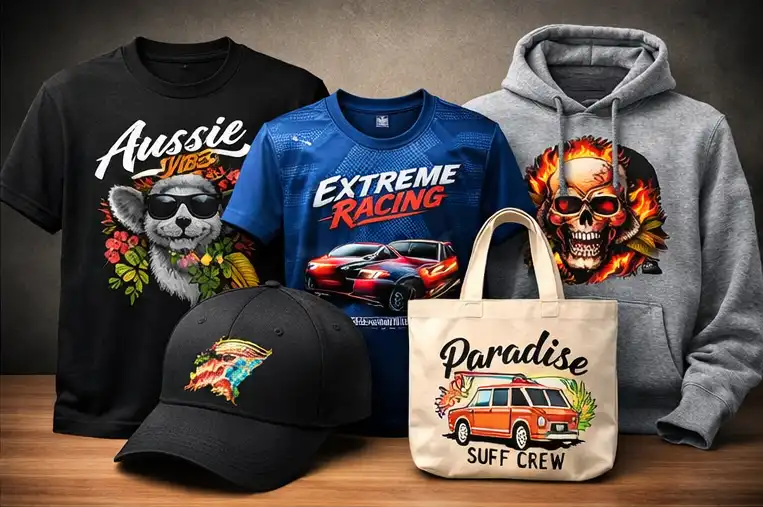
Get Started with DTF Printing Today
If you’re looking for a high-quality, durable, and cost-effective solution for custom apparel printing,
DTF transfers are the smart choice.
Explore our DTF printing services
or contact our team today
to get started.
Whether you need fast local production in Melbourne or nationwide delivery across Australia,
DTFhub is ready to support your business at every stage.